If you’re planning a trip to the United States, you’ve likely got two main options for staying connected: a physical prepaid SIM card, or a USA eSIM. Both get you online, but the experience of buying, setting up, and using each one is quite different. Here’s a practical comparison to help you decide which fits your trip better.
Why This Decision Matters More Than It Seems
Connectivity affects more than convenience. It shapes how you navigate, how you stay reachable, and how quickly you can sort out problems if something goes wrong during your trip. Choosing the wrong format can mean wasted time at the airport, an unexpected store visit, or being offline exactly when you need directions or a ride.
How Buying Each One Works
Physical SIM
You typically need to find a carrier store or airport kiosk after you land, wait in line, show identification in some cases, and get the SIM physically inserted or swap it yourself. If the kiosk is closed, out of stock, or has a long queue, you’re offline until you sort it out.
eSIM
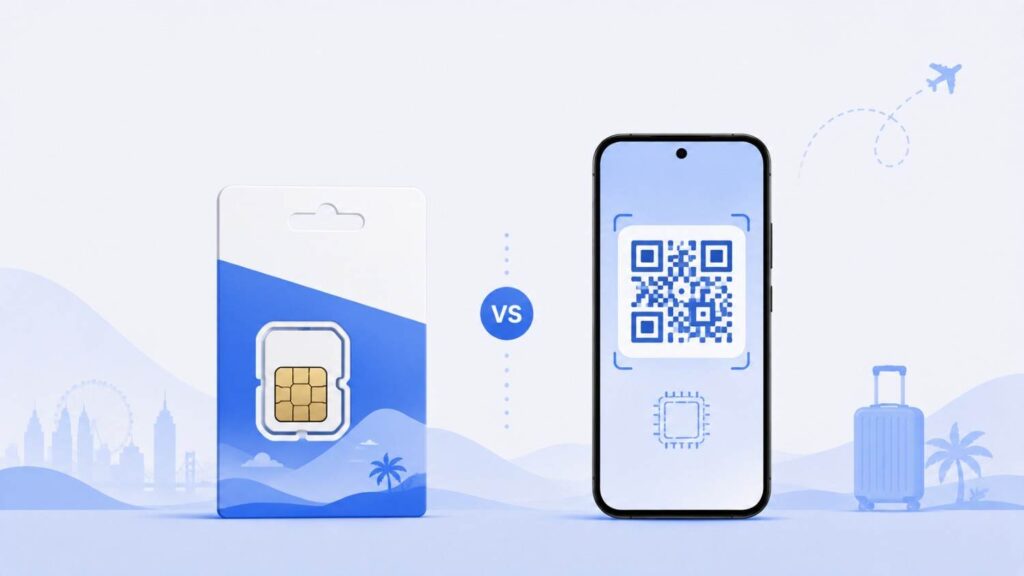
You purchase online, often before you even leave home. Your plan is delivered digitally, usually as a QR code, and you activate it whenever you’re ready. There’s no store, no queue, and no physical item to lose or forget.
Setup and Activation
Physical SIM
Requires physically removing your existing SIM (often needing a small ejector tool), inserting the new one, and waiting for your phone to register the new network. If you lose the tiny tray or SIM card, you’re stuck.
eSIM
Setup happens entirely in your phone’s settings. Scan a QR code, and your profile downloads and activates in minutes. There’s nothing to physically lose, and no tray to misplace.
Keeping Your Home Number Active
Physical SIM
Swapping to a physical SIM in a single-SIM-slot phone often means removing your home SIM entirely, which can disconnect you from calls, texts, and apps tied to your original number until you swap back.
eSIM
On most modern dual-SIM or dual-eSIM phones, your eSIM runs alongside your existing SIM. Your home number, WhatsApp, and other tied services keep working normally while your eSIM handles US connectivity.
Flexibility During Your Trip
Physical SIM
Switching plans or providers usually means buying another physical card, which may mean finding another store during your trip.
eSIM
You can typically purchase and activate a new eSIM plan digitally at any point, without needing to be near a physical retailer.
Cost Considerations
Pricing varies by provider and plan for both formats, so neither is inherently cheaper across the board. What often matters more is what’s included: data allowance, talk minutes, SMS, and validity period. Compare actual plan details rather than assuming eSIM or physical SIM is the cheaper option by default.
When a Physical SIM Might Still Make Sense
If your phone doesn’t support eSIM, a physical SIM is your only option, regardless of which is otherwise more convenient. It’s worth confirming your device’s eSIM compatibility before assuming you have a choice at all.
When eSIM Makes the Most Sense
If your phone supports it, eSIM is generally the more convenient choice for travelers who want to set up connectivity before departure, avoid store visits, and keep their home number active throughout the trip.
Frequently Asked Questions
Can I use both a physical SIM and an eSIM at the same time?
Yes, on most dual-SIM devices. This lets you keep your home SIM active while using an eSIM for US connectivity, or vice versa.
Is eSIM harder to set up than a physical SIM for someone who isn’t tech-savvy?
Not typically. Scanning a QR code and following on-screen prompts is usually simpler than physically handling a SIM tray and card.
What happens if my eSIM doesn’t activate properly?
Check our troubleshooting guide for common fixes, or contact support with your order ID.